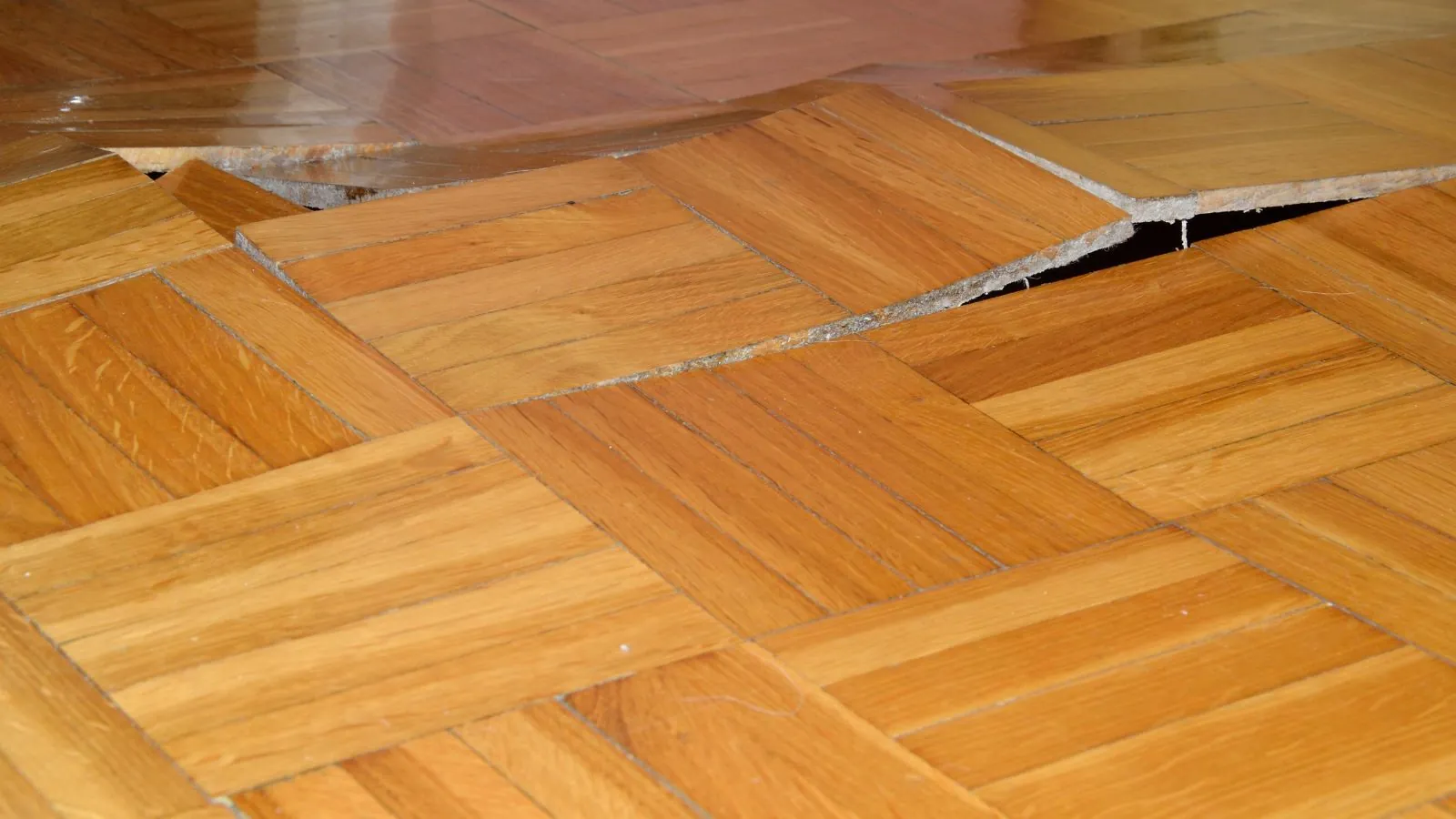
What water does to hardwood
Wood takes on moisture and swells. When the bottom of a board is wetter than the top, the edges rise and the board cups. When the whole floor swells with nowhere to go, it can buckle off the subfloor. Gaps appear later as the boards dry and shrink.
Solid hardwood, engineered wood and laminate behave differently. Engineered flooring has a plywood core that can delaminate. Laminate has a fiberboard core that swells and crumbles. Solid wood has the best chance of surviving a short wetting.
| Floor type | How it reacts | Chance of saving |
|---|---|---|
| Solid hardwood | Cups, crowns, buckles | Better if dried fast. |
| Engineered wood | Delaminates, edges lift | Moderate. |
| Laminate | Swells, core crumbles | Low. |
| Bamboo | Similar to hardwood | Moderate. |
Owners of older buildings can read about drying in the Cedar City Historic District.
Drying a hardwood floor
We use moisture meters to map wet boards, then dry the floor with air movers and dehumidifiers. For finished floors, specialized mats and panels draw moisture out through the surface. Boards that cup often flatten as they dry, so sanding comes only after readings stabilize.
The subfloor matters as much as the boards. If the subfloor stays wet, the floor will keep moving. We check below the floor by lifting a board or two when needed, and we dry the wall bases as well.
Do not sand or finish early
- Sanding a wet floor can lock moisture in and cause it to fail later.
- Do not cover wet boards with rugs or plastic.
- Leave the floor open so air can reach it.
Boards lifting?
Call to see if drying can save the floor.
When boards must be replaced
Boards that remain cupped after drying, have black staining from mold or water, or show rot are replaced. Matching an old floor takes care, and some finishes are discontinued. A flooring professional can blend new boards and refinish the whole room for an even look.
If water came from below, see slab leak damage. For wall-side moisture, see wall and drywall repair. Document readings so you can show the floor was dried before refinishing.
Timing matters. Floors dried within a few days have much better outcomes than floors left wet for weeks.
Moisture readings and why they decide everything
Wood floors are judged by moisture content, not by looks. A typical interior floor sits at a stable reading, and a wet floor reads several points higher. We take readings at the same spots each day, compare them with an unaffected area as a reference, and continue until the wet boards match that reference.
This matters for refinishing. Sanding and finishing before the boards reach equilibrium leads to gaps, cupping and finish failure months later. A written record of the readings also gives your flooring contractor and your insurer confidence that the floor is ready.
In Cedar City's dry climate, floors that were wet may shrink quickly once they are dried, so some gapping can appear during the winter heating season. That is normal movement, and it is different from permanent damage.
Staining, mold and what a dark board means
Dark gray or black stains on bare wood often mean the water sat long enough for mold or tannin staining. Light surface staining can sometimes be sanded out. Deep stains and soft, spongy boards are replaced.
If you smell mustiness from a floor that looks dry, read musty smell after water damage. The cause is often the subfloor, not the boards.
What hardwood floor water damage repair depends on
Hardwood cost depends on whether the floor dries flat or must be replaced.
Type of flooring
Solid wood, engineered wood and laminate respond differently.
Time wet
Faster drying saves more boards.
Extent
Larger areas need more equipment.
Finish
Refinishing the room is separate from drying.
Subfloor
Wet subfloor adds drying or replacement.
How insurance usually enters the picture
Sudden water events are often covered, while slow leaks may not be. Ask your insurer whether the policy treats flooring as a matched set, and keep before-and-after photos.
To scope yours, call (844) 950-6900
Safety steps and the standard behind the work
What to do first: stop the source if it is safe to reach, keep people and pets out of wet rooms, and photograph the damage before anything moves. What not to do: do not touch wet outlets, do not walk through standing water near panels, and do not run a household vacuum on water. Professional drying practice is described in the ANSI/IICRC S500 standard for water damage restoration, which sets out water categories and drying goals. This page is general guidance, and a site visit is what confirms the actual scope.
Questions Cedar City homeowners ask
Often, if dried promptly. Boards may flatten as moisture leaves.
No. Sand only after moisture readings are normal.
Typically several days to a couple of weeks, based on readings.
It can be dried in some cases, but delamination is common.
No. We dry and document. A flooring contractor handles refinishing.