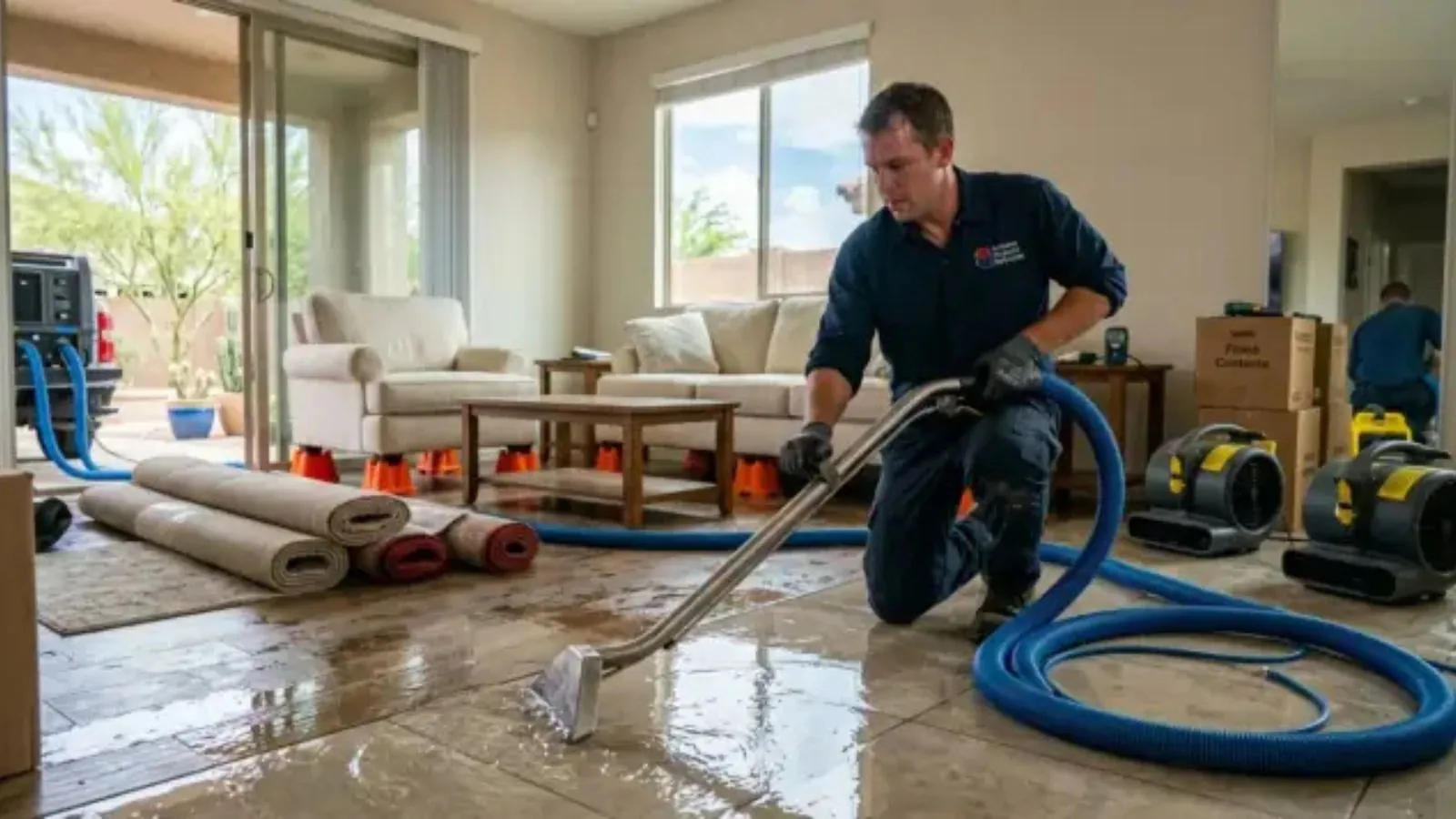
When standing water is an emergency
Any pooled water that is still spreading, covers carpet or wood flooring, or sits against a wall counts as an emergency. A single inch of water across 1,000 square feet of floor is about 623 gallons, which weighs roughly 5,200 pounds. That load does not stay on the surface for long.
Call before you start mopping. The faster the bulk water is removed, the less of it ends up inside the wall cavity, where it takes far longer to dry. After hours is the same as business hours for dispatch purposes, so a 2 a.m. supply line failure gets the same call.
Before anyone steps into the water
- Do not wade through water if outlets, cords or the panel might be wet. Cut power only if you can reach the panel while standing on a dry surface.
- If you smell gas or see sparking, leave and call 911 or the gas utility before you call us.
- Lift furniture legs off wet carpet with foil or plastic blocks, and move rugs, books and electronics to a dry room.
How we get the water out
The tool depends on depth and surface. Shallow water on hard flooring goes to a wet-dry extractor. Water over a few inches goes to a submersible pump that can move hundreds of gallons per minute. Soaked carpet and pad get a weighted extraction wand that pulls water out of the fibers instead of pushing it deeper.
We also check the water source and category before anything else. Clean supply water is treated differently from water that came up through a floor drain or in from the yard, and we document the difference in writing, because it changes what can be dried in place and what has to come out.
| What you see | Typical equipment | What comes next |
|---|---|---|
| A film of water on tile or vinyl | Wet-dry extractor, squeegees | Moisture readings along baseboards. |
| Soaked carpet and pad | Weighted extraction wand | Pad removal decision, then drying. |
| One to six inches in a room | Submersible pump, then extractor | Wall and subfloor moisture mapping. |
| Deeper water in a basement or garage | Trash pump with hose run outside | Sump check, then basement cleanup. |
Water on the floor tonight?
Same-day response when available. Call and describe what you see.
What extraction does not finish
Pulling the standing water is only the opening move. Drywall, baseboard, insulation and wood subfloor hold water long after the floor looks dry, and that trapped moisture is what drives swelling, odor and mold. Our crews follow extraction with moisture mapping and the equipment described on the structural drying page.
If water traveled behind a wall, the job moves into wall and drywall repair, where wet board and insulation are cut out in measured sections. Ask the dispatcher which of these stages applies to your loss, and what will be documented for your insurer along the way.
Cedar City monsoon water is not clean water
Southern Utah's late-summer thunderstorms are a real source of standing water here. A Utah Geological Association study of 2021 found that several storms exceeded the 100-year rainfall rate and flooded parts of Cedar City and Enoch, with more than ten separate floods running down Coal Creek that July and August.
Practical takeaway: water that comes in from the yard, a window well or a garage door during a cloudburst carries soil and runoff, so it should be handled as contaminated. See flood damage cleanup for how that changes the work, and do not run a household vacuum on it.
What shapes the price of water extraction
A written scope comes before work starts. These are the factors that move it.
Depth and volume
More gallons mean longer pump time and more hose and equipment.
Water category
Clean, gray or contaminated water changes disposal, protective gear and what materials can stay.
Access
Stairs, tight crawl openings and long hose runs add labor.
Flooring type
Carpet and pad, hardwood and tile each extract differently.
Time since the loss
Water that sat overnight has usually reached the wall base.
How insurance usually enters the picture
Sudden and accidental water, such as a failed supply line, is often covered by a homeowners policy, while groundwater flooding usually needs separate flood coverage. Check your policy and ask your insurer before you decide, and take photos before anything is moved.
Want your real number? Call (844) 950-6900
Safety steps and the standard behind the work
What to do first: stop the source if it is safe to reach, keep people and pets out of wet rooms, and photograph the damage before anything moves. What not to do: do not touch wet outlets, do not walk through standing water near panels, and do not run a household vacuum on water. Professional drying practice is described in the ANSI/IICRC S500 standard for water damage restoration, which sets out water categories and drying goals. This page is general guidance, and a site visit is what confirms the actual scope.
Questions Cedar City homeowners ask
Yes. The dispatch line is answered around the clock, including weekends and holidays. Tell the dispatcher where the water is coming from and whether you have shut off the main valve.
A small room can be extracted in a couple of hours, while a flooded basement can take much longer. The scope you receive before work starts explains the expected equipment and whether drying follows.
For a thin film on a hard floor, a wet-dry vacuum can help. For anything deeper, or any water that might be contaminated, wait for a crew. Never use a vacuum near wet outlets.
Sometimes. Clean-water carpet extracted quickly can often be dried in place, but the pad underneath is often replaced. Contaminated water means the carpet usually comes out.
Yes, see commercial water damage for how shops and offices are handled, including keeping part of the space open when that is possible.